Improved Wi-Fi for Cruise Ships via 6 GHz Thanks to the FCC and Cisco

Passengers and crew aboard cruise ships will soon be enjoying hugely improved Wi-Fi – Thanks to some new rules passed by the FCC and Cisco. 

A while back we reported on Cisco petitioning the FCC to allow 6 GHz Wi-Fi on cruise ships. Cisco first proposed the idea to the cruise industry back in January 2024, and ever since Cisco has been working with the FCC to get the rules changed. 

And now, as of February this year, the FCC has proposed a new rule which would allow 6 GHz Wi-Fi to be deployed and operated on cruise ships. 

This is great news for cruise passengers (as well as the crew) who will no longer have to suffer with sub-par Wi-Fi services on board the boat. Cisco is saying that significant progress has been made, and our expert Wi-Fi engineers here at Geekabit are excited to see it, both personally and professionally. 

Why is Wi-Fi big business on cruise ships?

In just a year, the US cruise industry will see 26 million passengers aboard their ships. And providing them with better connectivity while they are on board will make a huge difference – All thanks to introducing 6 GHz Wi-Fi.

The cruise liners we see today are more like floating cities than cruise ships. The cruise industry generates over US$25 billion in annual revenue and provides a huge 290,000 jobs. 

With thousands of passengers and crew on board each ship, there are a lot of connectivity needs to meet. People expect excellent connectivity wherever they go, and out at sea is no exception. 

Up until now, 6 GHz Wi-Fi has not been available for ships (you can find out why here). With the FCC proposal to allow low power indoor 6 GHz Wi-Fi, this is all set to change. Users will find a significant boost in quality and speed. 

Cisco is assisting the FCC by helping to verify that this access to the 6 GHz band will not cause interference to current users, both at sea and in port. 

Cisco’s Senior Director of Connectivity & Technology Policy Bill Davenport says:

“The FCC is recognising what passengers and crew have long experienced: Onboard connectivity often falls short of modern expectations. This welcome step begins the process of updating legacy rules that constrain network performance and opens the door to faster, more reliable internet at sea.” 

Will 6 GHz Wi-Fi on cruise ships cause interference to other users?

Expert Engineer at Cisco, Matt Swartz,  believes it is highly unlikely that indoor 6 GHz cruise Wi-Fi will interfere with incumbent satellite services or microwave links. 

Why won’t 6 GHz Wi-Fi on cruise ships cause interference?

Cisco Engineer Matt Swartz says: 

“Cruise liners can have as many APs as stadiums, sometimes more. Even an installed base of 4,000 APs is not uncommon for a single ship. Fortunately, most ship deployments have now moved APs into individual cabins, which means that Wi-Fi signals are well contained within the ship’s heavy steel and reinforced glass structure. We’re now working with the cruise industry to test and verify that there’s no risk of interference with incumbent services when using 6 GHz Wi-Fi at LPI levels within the ship.”

Why is there a drive for better Wi-Fi on cruise ships?

One of the significant drivers for improved Wi-Fi on cruise ships and other vessels has been the introduction of more robust and much faster satellite backhaul services at sea. 

Yes, we’ve experienced okay in-cabin Wi-Fi using the existing 5 GHz and 2.4 GHz operations, but we expect 6 GHz to make a big difference for connectivity, speed and quality within the ship’s high traffic areas including the ship’s entertainment venues. 

Much like a stadium or other large public venue, a busy cruise ship is a high density environment with thousands of different user devices all competing for the same spectrum within a small area. 

When the FCC gives permission for Cisco to go ahead, they will be using their high-density 6 GHz expertise to boost onboard connectivity for both passengers and crew, improving quality and speed significantly. 

Cruise ship Wi-Fi not just for leisure

We’ve focused here on the improvement that passengers and crew will see in terms of internet access and communications.

But better onboard cruise ship Wi-Fi can also be used for:

  • Ship operations
  • Messaging
  • Safety procedures

We would expect a positive decision from the FCC within the year. Better Wi-Fi when out at sea? We can’t wait. 

You can find the full FCC document here

People also ask…

You may be wondering one of these frequently asked questions yourself. 

Why was the 6 GHz Band previously not allowed on ships? 

6 GHz was originally prohibited on ships in order to protect EESS remote sensing measurements across the oceans. 

EESS stands for Electrical Energy Storage System. It’s a technology that captures and stores electrical energy for later use, like a rechargeable battery. These systems are important for ensuring reliable power supply. 

You can read more about this here.

Why is 6 GHz connectivity needed on cruise ships out at sea?

Whether you are a seasoned cruise ship guest or have never cruised out on the open ocean, you might question the necessity of needing connectivity when you’re not in port. 

Any business in the hospitality industry strives for the best possible guest experience. Wi-Fi is a huge part of that, whether you’re on land or out at sea. 

Some examples of needing a reliable Wi-Fi connection on board a cruise ship are:

  • To stream movies from ship data centers 
  • Experiencing AR/VR for gaming
  • Relying on a connection for dining and retail purposes 

Allowing 6 GHz Wi-Fi whilst out at sea not only enhances the cruise experience for guests but also provides reliable connectivity to support critical ship operations.

Reliable 6 GHz connectivity for Ship operations could include:

  • Real-time access to navigational data and weather forecasts via Wi-Fi 
  • Sensors to monitor engines, ship systems, facilities, and security applications 
  • Communication between cruise ships, port authorities, crew members, and passengers

Why is Cisco so interested in cruise ship connectivity? 

You might be wondering why Cisco is bothering to petition this? Connectivity in the cruise industry actually has the potential to be big business. 

The network on a cruise ship typically consists of 4000 Access Points, supporting more than 10,000 Wi-Fi devices as well as providing connectivity for ship operations.

Cruise ships are quite literally packed with guests. Cisco sees the importance of delivering the right high density connectivity onboard sea vessels. In the US alone, the cruise industry is worth $3.7 billion. 

Could 2026 Be Wi-Fi 7’s Breakout Year? Cisco Thinks So

Matt MacPherson, CTO at Cisco, says 2026 could reveal a Wi-Fi 7 turning point.

Wi-Fi 7 has long been in the pipeline, but with notably low adoption rates (especially in the United States) it might not seem that way. But now, according to Cisco, the stars have finally aligned for Wi-Fi 7 with the perfect timing of 3 main things seeing a marked turning point. . 

Cisco CTO Matt MacPherson believes 2026 will be the turning point for Wi-Fi 7 due to the alignment of:

  • Market conditions
  • Deployment readiness
  • Customer Demand 

Let’s take a look at each of these in turn to see what their convergence could mean for more widespread adoption of Wi-Fi 7. 

How Are Market Conditions and Device Readiness Affecting Wi-Fi 7 Uptake?

Devices are ready now. Top of the range phones from the likes of Apple and Samsung were compatible with Wi-Fi 7 last year (2025). In 2026 we’ll start to see this more across the board, to include other devices like laptops. Devices bought now are more likely to have Wi-Fi 7 compatibility. 

Can We Skip Wi-Fi 6E and Go Straight to Wi-Fi 7?

Wi-Fi 7 brings an essential refresh. Wi-Fi 6E unfortunately caused a degree of confusion, with many customers still using Wi-Fi 5 and wondering what the benefit was to upgrade to Wi-Fi 6E or just wait for Wi-Fi 7. Cisco is starting to see a long overdue refresh already, now that enough Access Points (APs) are finally available. Customers are more than ready to go to the next technology. Any confusion about whether to upgrade to Wi-Fi 6E is mopped up with the introduction of a new full generation – Wi-Fi 7.

Will Wi-Fi 7 Bring More Benefits to End Users?

The Wi-Fi 7 standard is set to be the most reliable generation yet. It’s jam-packed with features to provide a reliable connection, such as:

  • Multi-Link Operation (MLO) – This allows devices to dynamically choose the best path by using multiple bands simultaneously
  • Enhanced OFDMA and MU-MIMO – These provide more efficient resource allocation to handle more devices and data.

These features, sets of applications and services couldn’t be done before, resulting in a standard which expands the market for Wi-Fi. Wi-Fi 7 will grow its set of use cases, and should be able to handle the increased demand that will come with it. Cisco believes that everything is aligned for a big boom in the Wi-Fi market this year. 

Here’s 3 Reasons Why Cisco Thinks 2026 Will be Wi-Fi 7’s Breakout Year

In conclusion, as 2026 unfolds Cisco sees 3 main things leading to the breakthrough that Wi-Fi 7 needs.

  1. Availability of Wi-Fi 7 devices removing the barrier to wider adoption of the standard
  2. An increase in scale with a fresh demand is leading to a Wi-Fi standard refresh and deployment readiness
  3. Redefining what Wi-Fi can support realistically with new architectural features will mean Wi-Fi 7 devices can meet customer demand and expectations
6 GHz Wi-Fi on Cruise Ships? Cisco Petitions FCC to Allow It

A new presentation from worldwide technology leader Cisco is appealing to the Federal Communications Commission to allow 6 GHz low-power indoor Wi-Fi operations aboard cruise ships. You can read their petition in full here

The Federal Communications Commission (FCC) is an independent agency of the United States government that regulates interstate and international communications by radio, television, wire, satellite, and cable. It plays a crucial role in managing the nation’s communications infrastructure and ensuring fair competition, public safety, and media responsibility. 

Cisco and the FCC met last week where Cisco delivered their presentation appealing for 6 GHz to be allowed on cruise ships. 

In their report, Cisco say that 19 million passengers per year are transported by the cruise industry in the US, and growing at a rate of 4.5% every year.

Why is the 6 GHz Band Not Allowed on Ships? 

6 GHz was originally prohibited on ships in order to protect EESS remote sensing measurements across the oceans. 

EESS stands for Electrical Energy Storage System. It’s a technology that captures and stores electrical energy for later use, like a rechargeable battery. These systems are important for ensuring reliable power supply. 

However, EESS has now moved away from the 6 GHz band, making the restriction redundant. 

Back in 2023, the World Radiocommunication Conference decided to migrate EESS ocean sensing operations out of the 6 GHz band, making the original 6 GHz prohibition obsolete.

EESS operations are to transition to 4200-4400 MHz and 8400-8500 MHz frequency bands. This allocation of a new frequency has meant that there is already support for lifting the prohibition on unlicensed operations. There is a clear legal framework that enables the targeted Wi-Fi exemption for cruise ships. 

There are existing statutory definitions that the FCC can rely on that distinguish cruise ships from other types of boats and vessels. For example:

  • Cruise ships must be over 100 gross tons in weight, 200 feet in length, carrying more than 12 passengers. 
  • Vessels must travel defined routes lasting over 24 hours on high seas, embarking passengers in U.S. territories. 
  • Charter vessels and tour vessels must weigh less than 100 tons gross, making them statutorily distinct.
  • Cruise ships include multiple decks, restaurants, bars, spas, casinos, resembling hotels more than boats.

Why is 6 GHz Connectivity Needed on Cruise Ships Out at Sea?

Whether you are a seasoned cruise ship guest or have never cruised out on the open ocean, you might question the necessity of needing connectivity when you’re not in port. 

Allowing 6 GHz Wi-Fi whilst out at sea not only enhances the cruise experience for guests but also provides reliable connectivity to support critical ship operations.

6 GHz Connectivity for Guest Services on Cruise Ships

They might be on holiday but passengers are likely to still want to stay connected. Let’s face it, we tend to feel a bit lost when we don’t have a reliable connection at our fingertips. Cruise ship passengers will still want the opportunity to:

  • Stream movies from ship data centers 
  • Experience AR/VR for gaming
  • Rely on a connection for dining and retail purposes  
  • Access advisories
  • Communicate via the ship’s app
  •  Make Wi-Fi calls 

Any business in the hospitality industry strives for the best possible guest experience. Wi-Fi is a huge part of that, whether you’re on land or out at sea. 

A weak, poor or non-existent Wi-Fi performance at sea will affect promenade, pool, coffee shops, and other on-board guest services.

Reliable 6 GHz Connectivity for Ship Operations

Cruise ship guests might be on holiday but the crew members are not. Those that work on cruise ships will rely on a strong, reliable connection for a range of things. 6 GHz will provide Wi-Fi connectivity to facilitate:

  • Real-time access to navigational data and weather forecasts via Wi-Fi 
  • Sensors to monitor engines, ship systems, facilities, and security applications 
  • Communication between cruise ships, port authorities, crew members, and passengers 

Over 4,000 access points are deployed throughout cruise ship hallways, ceilings and cabins to help support all of the above for both guest services and ship operations. 

Allowing the 6 GHz band on cruise ships will enable wider channels for optimizing operations and the avoidance of excessive collisions.

Why is Cisco Interested in Cruise Ship Connectivity? 

Perhaps you’re wondering why Cisco is bothering to petition this? 

Well connectivity in the cruise industry actually has the potential to be big business. The network on a cruise ship typically:

  • Has 4000 Access Points
  • Supports more than 10,000 Wi-Fi devices
  • Provides connectivity for ship operations

Cruise ships are quite literally packed with guests, and whilst they might well be trying to escape what’s back home, no one can resist sharing that sunset selfie from their cabin window with the open ocean at their back. 

Cisco has a point and we’d agree that it is important to deliver the right high density connectivity onboard sea vessels. 

In the US alone, the cruise industry is worth $3.7 billion. 

6 GHz Wi-Fi on Cruise Ships

So if you’re a regular cruise ship passenger or you’re considering becoming a cruise ship guest in the future, you might just find yourself well connected via 6 GHz whilst on your travels thanks to Cisco. 

Wi-Fi whilst out on the open sea? Yes please. 

Strong Growth of Enterprise WLAN Market in 2023 Q1 

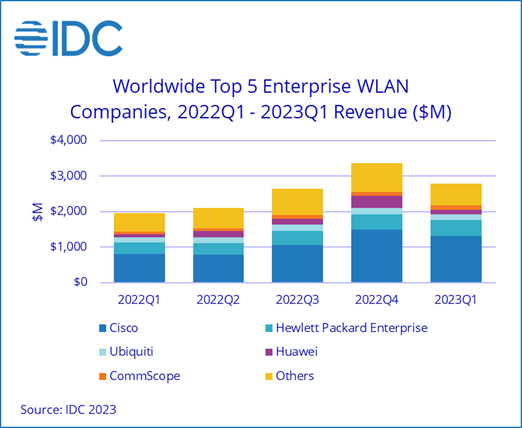
The International Data Corporation (IDC) Worldwide Quarterly Wireless LAN Tracker has reported that between the first quarter of 2022 and Q1 of 2023, the Enterprise Wi-Fi market has grown by 43%. 

What’s Behind the Growth of the Enterprise WLAN Market?

The driving force behind the Enterprise WLAN market growth is in part down to the easing of component shortages. 

There has also been a significant demand for the upgrades and expansions that come with Wi-Fi 6 and Wi-Fi 6E. 

You can find further details on this in IDC’s latest market report. 

Wi-Fi Market Back With a Vengeance

Previously, the right business to be in might have been as a service provider or consumer Wi-Fi. But we’ve come a long way since 2020, and from just last year even. The IDC reports that the consumer Wi-Fi segment has decreased by 8.8% for the quarter year-on-year.

The enterprise Wi-Fi market however is back and booming and showing itself to continue to grow year-on-year. 

The IDC’s recent report showed that the Enterprise Wi-Fi market grew by 43% in Q1 for 2023 (year on year). This sector is worth a huge 2.8 billion dollars. 

Is the Growth of Enterprise WLAN Market Down to Wi-Fi 6?

Of the Enterprise WLAN sector revenue, Wi-Fi 6 made up 78.6%. 

In addition to that, the adoption of Wi-Fi 6E is up by 14% from that last quarter of 2022. This continued growth has taken a 10.4% share of the AP market in Q1 of 2023. 

Cisco Expands Market Dominance

At the end of the first quarter of 2023, Cisco continued to take their Enterprise Wi-Fi market share with 47.1%. Their revenue has risen 62.7% year on year – Their Enterprise Wi-Fi revenue for this quarter was 1.3 billion US dollars. 

Also doing well in the Enterprise Wi-Fi market is HPE_Aruba (Aruba Networks). They have grown by 39.5% year on year for Q1 of 2023. The IDC reports they have a market share of 16%. 

You can check out how other vendors are doing by heading to the IDC website here

UniFi vs Meraki vs Aruba

If you’re in the market for a bit of wireless kit then you’re rather spoilt for choice nowadays. Whilst it’s great to have a choice of products, it does beggar the question, how do I choose the right wireless product for my business?

Some of the big players when it comes to wireless network products are Ubiquiti, Meraki and Aruba. But which one is right for your specific deployment? Let’s have a look at them one by one.

Ubiquiti Network Wireless Products

We’ve spoken a lot about Ubiquiti and their range of wireless products – They are a firm favourite with our Wi-Fi experts here at Geekabit. Ubiquiti provide a range of wireless networking products including access points, wireless controllers, antennas and wireless bridges. Whatever your Wi-Fi requirement, they’re likely to have a product solution.

Product Portfolio

  • Ubiquiti have the product range to meet a complete enterprise network
  • They cover both wireless and wired products
  • They have the management and security systems to go alongside

The Benefits for Small to Medium Sized Business Networks

  • They are easy to deploy and use
  • Lots of features
  • One intuitive User Interface to make the human-computer interaction as simple as possible
  • Unbeatable value

The Benefits for Enterprise Networks

  • All access points, switches and routers are easy to manage from one Use Interface
  • It has central management capabilities and troubleshooting
  • It is straightforward to use for network admin staff, with no certification needed
  • Cloud and on-premises management available
  • Very high access point performance
  • Good HD Wi-Fi control capabilities

The Benefits for Arena / Stadium Networks

  • They can provide arena access points with integrated high gain antennas
  • One access point can have up to 3 5GHz client serving radios
  • Multi 5 GHz radio access points save in installation and cabling costs
  • Outstanding performance in a high traffic environment

User Experience

  • Quick and easy deployment with no licenses required
  • A single, intuitive user interface for all Ubiquiti elements with secure remote access
  • It’s easy to expand the network if and when needed without additional licenses
  • They provide free support (without needing a support agreement) plus a community of Ubiquiti users for extra support, buffered by Ubiquiti employees

Price-point

  • The price-point for Ubiquiti wireless products is low compared to other brands, offering fantastic value for money

Meraki Wireless Products

The Meraki MR series from Cisco delivers Wi-Fi 6 access points, faster access point deployment, simplified administration, and richer visibility.

Product Portfolio

  • Meraki have the product range to meet a complete enterprise network
  • They cover both wireless and wired products
  • They have the management and security systems to go alongside

How it Fares for Small to Medium Sized Business Networks

  • They are easy to deploy and use
  • You have to pay a subscription fee, which renders the product useless if not paid
  • It works well for smaller businesses and enterprises, apart from it being expensive
  • For better prices, you need to commit to several years and pre-pay

How it Fares for Enterprise Networks

  • It is easy to deploy and use cloud infrastructure
  • There is no on-premises option
  • Performance falters with high traffic
  • Ongoing licensing is expensive

How it Fares for Arena / Stadium Networks

  • There are no capabilities specifically targeted to venues of this size or type
  • For focused radio frequency, external antennas are required which will incur extra costs and will need mounting
  • There are no multi 5 GHz radio products, and RF tuning capabilities are weak
  • HD Wi-Fi performance is weak

User Experience

  • Quick and easy deployment but a lack of flexibility may cause problems
  • Licensing is required, but all features are included
  • It has a single, intuitive user interface
  • Support services are available from Meraki, but a service subscription is required. Without it there is no support
  • Additional support is available at an additional cost

Price-point

  • The price-point for Meraki MR wireless products is high compared to other brands, with licensing and subscription fees pushing it up.


Aruba Wireless Products

The range of Aruba Access Points deliver a fast, reliable Wi-Fi solution with great performance levels and a boost to network efficiency. They will also support the growing mobile and IoT density demands on your network.

Product Portfolio

  • Aruba have most of the product range to meet a complete enterprise network need
  • They cover both wireless and wired products
  • They have the management and security systems to go alongside

How it Fares for Small to Medium Sized Business Networks

  • Controller based products can be difficult to deploy and use
  • Instant access points lack features unless you have other Aruba products such as Aruba Central or Aruba AirWave licenses
  • Aruba Central has a good cloud-based product for small to medium sized business, but it is very expensive

How it Fares for Enterprise Networks

  • Large configurations can handle large networks
  • The base product is a traditional single tenant hardware controller which can make it difficult to deploy and use
  • For adequate reliability, you will need redundant controllers which are pricey
  • The Aruba instant access points are not sufficient for larger enterprises or multisite premises
  • Aruba Central provides a cloud alternative but uses separate licenses for features. This means that you may require additional licenses for future functionality which could prove very expensive
  • The ongoing admin of handling expiring licenses is time consuming

How it Fares for Arena / Stadium Networks

  • As with Meraki, for focused radio frequency with Aruba products, external antennas are required which will incur extra costs and will need mounting
  • There are a maximum of 2 5 GHz radios per access point
  • The Aruba multi 5 GHz access points have filtering
  • HD Wi-Fi performance is weak

User Experience

  • Deployment is difficult, with added complexity of ensuring you have the right licenses which can be time consuming
  • Depending on the products used, you may require multiple user interfaces
  • Expanding your network or adding new features may require additional licensing and subsequently more costs
  • Aruba does provide support within a 90-day product failure warranty. Additional support after that requires a paid support agreement. If you don’t pay, you don’t get support

Price-point

  • The price-point for Aruba wireless products is lower than Meraki but medium compared to other brands. As with Meraki, the costs involved with licensing and subscription fees with Aruba pushes the price up.


Still not sure what wireless products you need for your network?

If you’re unsure what wireless products would be suitable for your network – Whether it be small or arena sized – Our Wi-Fi experts would be happy to chat through the options. Our experienced Wi-Fi engineers can match the right wireless network products with your requirements to get you the most reliable Wi-Fi possible. Let’s strengthen your connections today – Get in touch now.